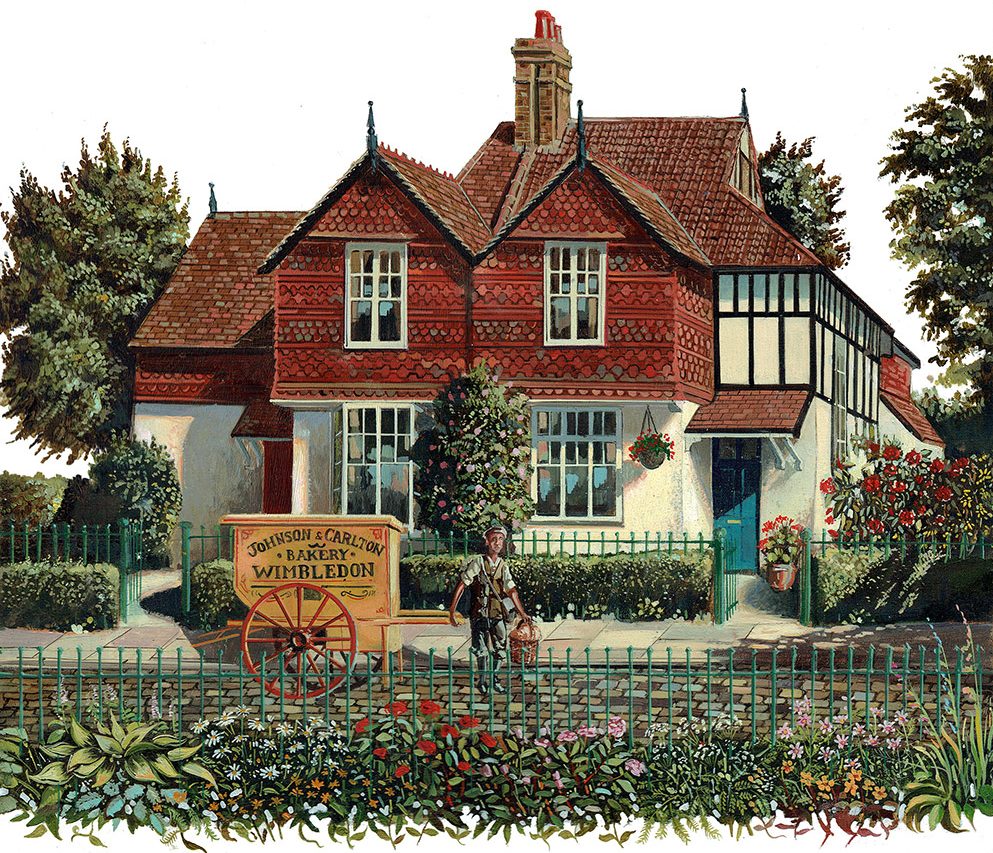
In recent months, I was commissioned to paint a house in Wimbledon, London. An interesting aspect of this project was that the client asked me to depict the house as it would have appeared in the late 19th century, when it was first built.
The client supplied several photographs from that period, and I was pleasantly surprised to see that not much had changed. A few roof details were different, and at that time there was an iron fence at the front of the property.
This fence was most likely removed during the Second World War as part of the nationwide effort to collect metal for the war industries. In reality, this campaign served largely as morale-boosting propaganda; the collected metal resulted in a massive oversupply, and much of it was not of sufficient quality to be of real use. Rumours persist that a large portion was ultimately dumped into the Thames Estuary.
Another significant difference, of course, was that in the 19th century the streets were mostly cobblestoned.

In conversation with the client, I suggested including a contemporary feature from that era, such as a delivery cart. My research led me to a local baker, Johnson & Carlton. They established their shop in the late 19th century and were located between Worple Mews and Mansell Road, Wimbledon. It appears they also operated several tea shops, no doubt selling bread and cakes as part of their service.
Sadly, Johnson & Carlton is no longer in operation, having closed sometime in the 1960s. Nevertheless, they live on in my painting.
One of the great things about my job is the opportunity to learn about local history. Sometimes the smallest details can have the greatest impact in illustrating what life was like over 150 years ago.
The client was very pleased too!